|
David C.B. Mills page 5 |
Page 1/Page 2/Page 3/Page4/Page5/Page6/Page7
David Cyril Bertram Mills
(5/20/33-2/8/02)
Memorial Service 4/21/02
So who was David Cyril Bertram Mills? First, David was a circus man, or perhaps I should say an anti-circus man, since he was born into and subsequently rebelled against a very wealthy family that ran the Cyril Bertram Mills Circus in the United Kingdom, the equivalent of the Ringling Brothers, Barnum and Baily Circus in the United States. His rebellion against wealth and aristocracy informed his world view as an eccentric, a socialist, a champion of the common man and an elitist intellectually. He was a highly moral and ethical man, with a compassion for the disadvantaged and an intolerance for dishonesty and mediocrity. Our friend and colleague, Richard Haslam, has characterized David as “intensely interested in discovering ‘the truth’ in a philosophical sense. His ruthless self-criticism and honesty made him a shining example to students and peers of how a professional scientist should think. David enjoyed science for its own sake and saw it as one of the purest of human activities. He was not impressed by the move to patent and commercialize research results. David was classically educated, with a broad and deep interest in science, history, philosophy, literature, and art. The excitement of the free exchange of ideas dominated his interactions with colleagues and friends.” He was an avid bell-ringer participating in change-ringing in nearly 1,000 church towers in England and North America.
Since David’s origins were in the circus and since he identified himself with circus people rather than those who used them, it is not surprising that within David there was something that conjured up the deeply philosophical idea of the clown in the sense of the court jester who is unique in being chosen as the only one able to poke fun at the king and keep his head. He was a man who could make us laugh because of who he was and how he behaved in relation to who we are and how we behave. In my relationship with David, I attained a sense of who I am. A clown also epitomizes the tragic and comic figure of the outsider detached from and larger than life and in touch with the absurdity of life. David, like the clown, was a man who was deeply in touch with both the joy and suffering life brings.
Marny and I had the good fortune of visiting David for two days in his home in Rushbury, near Church Stretton last summer. I have a picture in my mind of David striding barefoot with great leaping strides over the hills of Shropshire, drenched in sunlight and rain, eagerly breasting each hill and rounding each corner with insatiable curiosity, exactly as he encountered every moment of his experience of life. It seemed that David saw himself as part of a larger communal “us”. His willingness if not insistence to dissolve his ego into a communal society of his own choosing led him inevitably to bell-ringing, a quintessentially communal affair. He experienced himself as part of a whole, but only a whole of his own choosing, and his choice of associates was based on the highest ethical standards. We can all justly feel truly gratified – proud is not the right word, for pride was the antitheses of David – that he chose us all to be his friends.
Peter N. Walsh
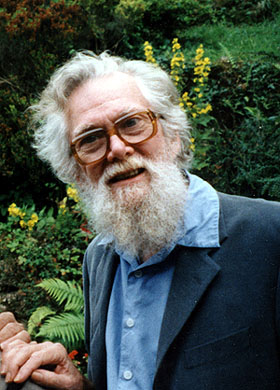
Picture of David Mills on this page by Bruce and Eileen Butler.
David Cyril Bertram Mills
(5/20/33-2/8/02)
David Mills, a beloved faculty member at Temple University School of Medicine, died at the age of 68 on Friday, February 8, 2002. He was a Professor of Pharmacology and a member of the Sol Sherry Thrombosis Research Center who had recently retired and moved to the village of Rushbury near Church Stretton in Shropshire, England. David received the B.A. and M.A. degrees in Biochemistry from Cambridge University. After serving as Scientific Officer in the Biochemistry Department of Glaxo Research Ltd. (1957-1965), he joined Gustav Born’s Medical Research Council Thrombosis Research Group in the Department of Pharmacology at the Royal College of Surgeons, London, England (1965–1971), receiving his Ph.D. from the University of London in 1970. He was recruited as one of the founding members of the Thrombosis Research Center at Temple University School of Medicine in 1971 where, over a period of 30 years, he worked on the mechanisms of platelet aggregation by ADP and other agonists, the control of platelet responsiveness by agents that influence cAMP metabolism, the biochemical characterization of qualitative platelet defects, and the identification and characterization of platelet ADP receptors by photoaffinity labeling utilizing novel analogs of ADP. With Richard J. Haslam and with J. Bryan Smith, he investigated mechanisms of metabolism of adenosine diphosphate and the control of platelet responsiveness by agents (including adenosine) that he found to influence cyclic AMP metabolism. With his colleague, Donald E. Macfarlane, he presented the first convincing evidence, utilizing an ADP analog, 2-methylthio-ADP that platelets have a receptor for ADP which inhibits cyclic AMP accumulation that is distinct from the receptor inducing platelet aggregation and shape change. He was successful at identifying a receptor for ADP on human blood platelets utilizing photoaffinity labeling with a new analog of ADP, 2-(p-azidophenyl)-ethylthioadenosine-5'-diphosphate (AzPET-ADP). These studies resulted in the identification of an ADP receptor, by which ADP inhibits adenylate cyclase, which is likely to be identical to the P2Y12 ADP receptor recently characterized by molecular cloning. These research activities resulted in more than 100 publications reporting seminal observations on receptor mediated platelet activation.
David was intensely interested in discovering ‘the truth’ in a philosophical sense. As a result, he was scrupulously careful in planning experiments, in devising a full range of controls and in interpreting his data. His ruthless self-criticism and honesty made him a shining example to students and peers of how a professional scientist should think. David was one of the rather small group of pioneers, who in the 60s and early 70s, began to approach platelets as pharmacological and biochemical objects, rather than simply as a subject for traditional hematological study. This approach led to an explosion of knowledge about platelet function, and revealed generally applicable paradigms concerning the regulatory roles of prostaglandins, cyclic AMP, intracellular calcium shifts and protein kinase C.
Above all, David enjoyed science for its own sake and saw it as one of the purest of human activities. He was not impressed by the move to patent and commercialize research results. The excitement of the free exchange of scientific ideas dominated his interactions with colleagues, whether they were collaborators, visitors from another laboratory, or friends met at meetings. Concepts developed during these periods of intense intellectual activity rapidly infected the whole field: David’s contributions, though considerable, were often untraceable and unacknowledged. For over 20 years, David was a highly respected member of this informal network of scientists.
David was classically educated, with a broad and deep interest in science, history, philosophy, literature, and art. He was an avid bell-ringer participating in change-ringing in nearly 1,000 church towers in England and North America. He was a highly moral and ethical man, with a compassion for the disadvantaged and an intolerance for dishonesty and mediocrity.
David is survived by two sons (Alexander and Gerald) who live in Philadelphia and by two sons (Nick and Greg), two daughters (Bea and Seleny) and a sister (Roseanne) who live in the United Kingdom. His colleagues at Temple University and around the world remember him as a brilliant scientific thinker and a Renaissance man.
Richard J. Haslam
Donald E. Macfarlane
J. Bryan Smith
Peter N. Walsh